

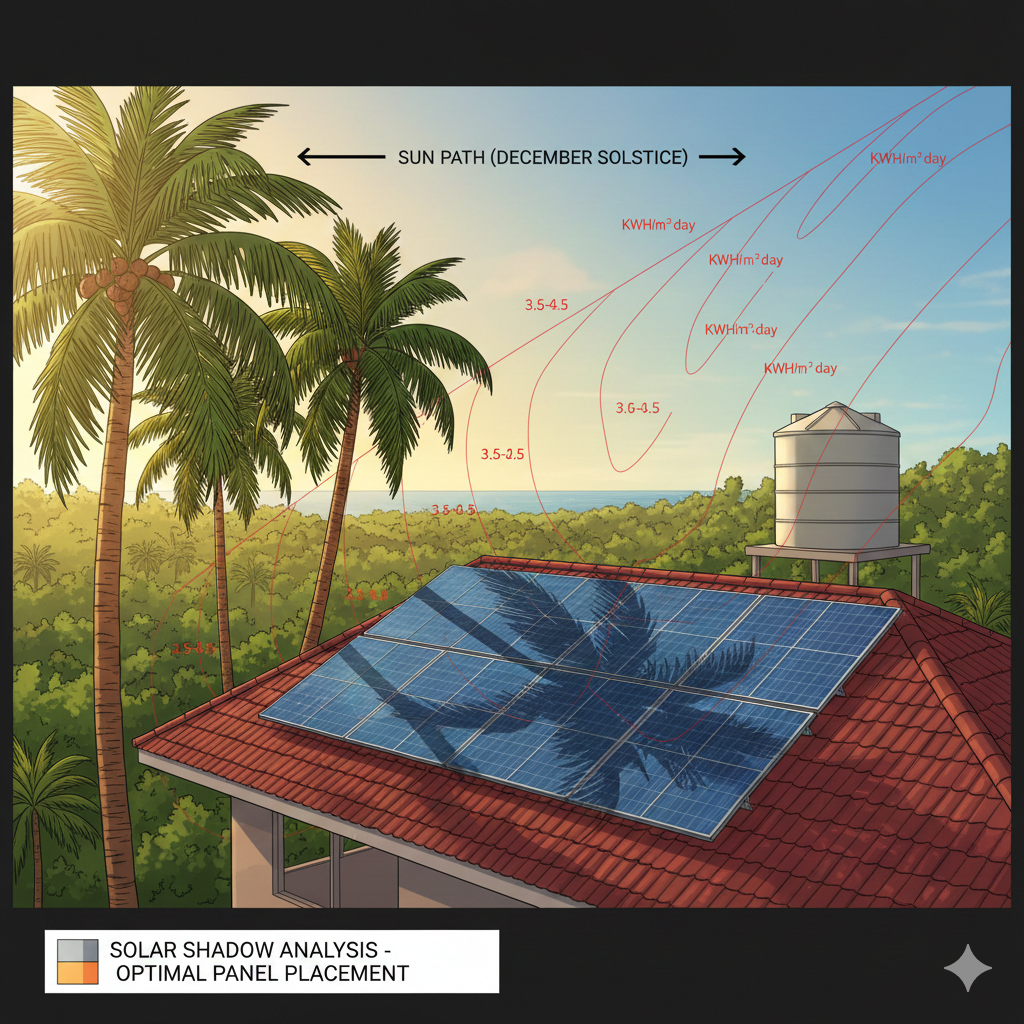
Solar Shadow Analysis: Can I Install Panels Near Coconut Trees or Water Tanks?
“Sir, I have a big overhead water tank—can we put panels next to it?”
“Sir, my neighbor has a huge coconut tree. Will it affect generation?”
In Tamil Nadu and Pondicherry, open, empty rooftops are rare. Most homes have obstacles like water tanks, staircase rooms, dish antennas, or even a neighbor’s tall building. Understanding shadows can mean the difference between a system that generates 15 units/day and one that produces only 5 units/day.
Here’s why shadows are dangerous—and how 2026’s advanced technology solves it.
1. The “Garden Hose” Effect (Why Shadows Stop Power)
Think of your solar string like a long garden hose. If you pinch it at one point:
- Does water flow just there? No—it stops along the entire hose.
Solar panels connected in series strings behave the same way.
Example:
- 10 panels in series → Total voltage = 400V
- Shadow falls on Panel #1
- Result: Current is blocked → All 10 panels stop working
Even a tiny shadow can shut down the entire string, not just the shaded panel.
2. Bypass Diodes: The Old Guard
Standard panels have bypass diodes in the junction box to detour current around shaded cells.
- Benefit: Other panels keep working.
- Cost: You lose the power of the shaded module (~300W).
- Risk: If a shadow is constant for years, the diode overheats and fails → panel becomes an open circuit.
3. Half-Cut Cell Technology: The 2026 Standard
Modern Half-Cut Mono PERC panels (Waaree, Adani TopCon) divide each panel in half.
- Top Half: Circuit A (independent)
- Bottom Half: Circuit B (independent)
Benefit:
- Morning shadow on the bottom half → top half continues at 100%
- Power loss is reduced → instead of 0W, you generate ~270W
For homes with parapet walls, water tanks, or nearby trees, Half-Cut panels are essential.
[Get a Shadow-Free Design Quote]
4. Hotspots: The Hidden Danger
- Permanent shadows, bird droppings, or wires on panels create hotspots.
- A shaded cell acts like a resistor → heats up to 150°C+
- Risks: Glass cracks, backsheet melts, or even fire
Surya’s Rule: No permanent shadow between 9 AM – 3 PM (peak sun hours). Early morning or late evening shadows are acceptable.
[Get Shadow Report]
5. The “Safe Distance” Formula
We calculate using the sun’s path (Cuddalore latitude 11.7°N).
- December (Winter Solstice): Sun is low → shadows are longest
- June (Summer Solstice): Sun is overhead → shadows are shortest
2X Rule: Obstacle height HHH → panels should be placed at least 2 × H south of it.
Example:
- Water tank height = 6 ft
- Safe distance = 12 ft to stay shadow-free in December
6. Coconut Trees: The Special Challenge
Neighbor’s trees are common in rural Tamil Nadu. Solutions include:
- Trimming: Temporary fix (fronds grow back in 4 months)
- Elevated Structure: Raise panels 8–10 ft above obstacles (adds ₹25k)
- Power Optimizers / Micro-Inverters (Enphase): Each panel works independently
- Panel A shaded → Panel B still generates 100%
- Makes “impossible” roofs usable, though adds ~₹1 Lakh
Summary:
- Shadows drastically reduce output if not planned for.
- Half-Cut panels, careful placement, and optional micro-inverters ensure maximum ROI.
- We simulate your roof 365 days/year before installation to guarantee optimal energy production.