

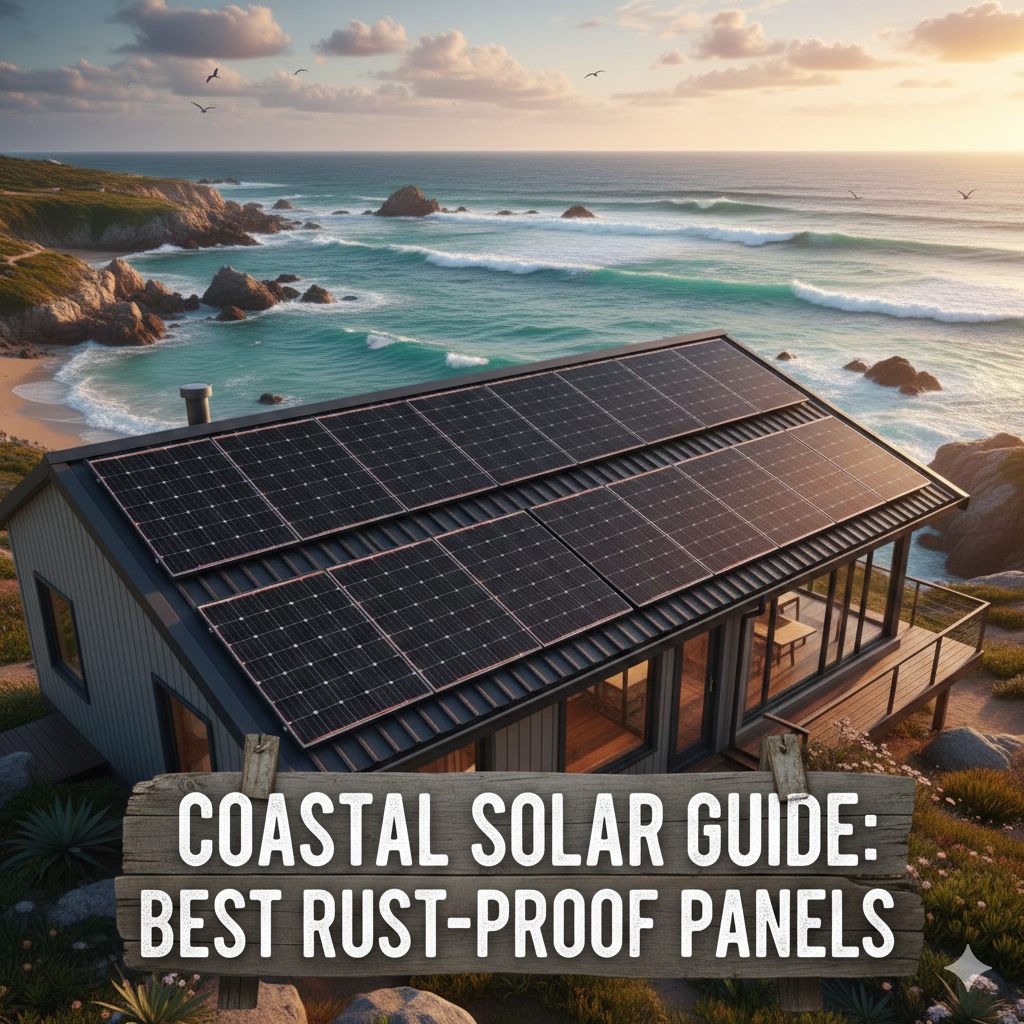
Chennai and Pondicherry enjoy abundant sunshine—but they also face a silent, destructive enemy: salt mist.
If your home is within 10 km of the Bay of Bengal—Besant Nagar, Thiruvanmiyur, Ennore, Royapuram, White Town, or even stretching toward Mahabalipuram—the air constantly carries microscopic salt particles.
The Impact
- Ordinary iron rusts within months
- Aluminium starts pitting
- Low-grade plastics become brittle and crack
The Reality
We have personally inspected “budget” solar plants near the coast that collapsed within 3 years—bolts eaten away by corrosion, panels failing due to salt intrusion, entire structures weakened beyond repair.
A solar plant in 2026 is expected to last 25 years. Near the coast, it won’t survive 5 years unless it’s designed specifically for saline environments.
This guide explains exactly how to coastal-proof your solar plant using proven material science.
Solar Panels: Why “Standard” Panels Fail Near the Sea
Not all panels are built for coastal conditions. Most standard modules are tested for inland climates like Bangalore or Coimbatore. Install them near the sea—and failure is inevitable.
Common Failure Modes
- Frame Corrosion: Aluminium frames oxidize and turn powdery white
- Delamination: Salt mist penetrates seals between glass and frame
- PID (Potential Induced Degradation): Sodium ions attack the cells, causing 30–40% permanent power loss
The Non-Negotiable Requirement: IEC 61701 Certification
Panels must be tested for salt mist corrosion—but certification levels matter.
| Severity Level | Environment | Suitability |
|---|---|---|
| Level 1 | Marine vessels | Overkill |
| Level 2–5 | Moderate salt exposure | Not sufficient |
| Level 6 | Salt mist + high humidity | MANDATORY |
DSS Standard:
For all coastal installations in Chennai and Pondicherry, we use IEC 61701 Severity Level 6 certified panels only (select Tata Power, Adani, Waaree series). These feature:
- Thicker anodized frames (20 microns vs 15)
- Salt-resistant silicone sealants
- PID-resistant cell technology
Mounting Structures: What Actually Survives Cyclones & Salt
Your panels are only as strong as the structure holding them—especially in high-wind coastal zones.
❌ Option A: Painted Mild Steel (The Cheap Trap)
- Spray-painted black iron pipes
- Paint scratches during installation
- Salt attacks exposed metal immediately
- Rust visible in 6 months, unsafe by Year 3
Verdict: Never use this—no exceptions.
✅ Option B: Hot-Dip Galvanized Steel (The Gold Standard)
- Welded first, then zinc-dipped at 450°C
- 80+ micron zinc coating
- Self-healing via cathodic protection
- Designed for cyclonic wind zones
Verdict: Best choice for elevated rooftop structures.
🥇 Option C: Anodized Aluminium (Premium Choice)
- 6063-T6 aluminium alloy
- Naturally corrosion-proof
- Lightweight and permanent
Verdict: Ideal for sheet roofs and low-height installations (higher cost).
Fasteners: The ₹500 Mistake That Destroys Systems
Most failures don’t start with panels—they start with bolts.
The Problem: Galvanic Corrosion
When incompatible metals touch in salty air, they form a battery. The weaker metal dissolves rapidly.
DSS Protocol
- SS 304 stainless steel fasteners only
- EPDM rubber washers to isolate metals
- No self-drilling screws—ever
This prevents corrosion at the joints where most systems fail first.
Cyclone Protection: Lessons Learned the Hard Way
Chennai is a high-wind coastal zone. Solar structures behave like sails unless properly anchored.
Our Wind-Safety Design
- Chemical anchoring (Hilti/Fischer) instead of plastic plugs
- Concrete pedestals for weight and uplift resistance
- Raised legs to avoid standing water and corrosion
- Waterproofed penetrations to protect your roof
Built to withstand wind speeds up to 180 km/h.
Maintenance Near the Sea: The Salt Crust Effect
Coastal maintenance isn’t just about dust.
What Happens
- Morning dew absorbs airborne salt
- Sun evaporates water
- Hard saline crust forms on glass
The Rule
- Clean panels every 10 days
- Use fresh water only
- Never use salty bore water (TDS > 500 ppm)
Salt deposits permanently etch glass if ignored.
Warranty Fine Print Most People Miss
Many budget panel brands quietly include this clause:
“Warranty void if installed within 500 meters of coastline unless specifically certified.”
That means a failure in Year 4 could be rejected simply because you live near the beach.
We verify coastal warranty clauses for every panel brand we install—so claims are never denied later.
Build It Right. Build It Once.
A cheap quote near the coast usually means:
- Low-grade steel
- Level-1 panels
- Rusting bolts
- Zero long-term accountability
In coastal regions, that’s not saving money—it’s throwing it away.
At DSS, we are locals. We know what salt air does to gates, grills, and rooftops. Our systems are engineered to survive coastal Chennai—not showroom conditions.
Living near the beach?
Contact DSS for a specialized coastal solar consultation. We’ll assess your exact location and recommend the exact material grades needed—before corrosion becomes a problem.